
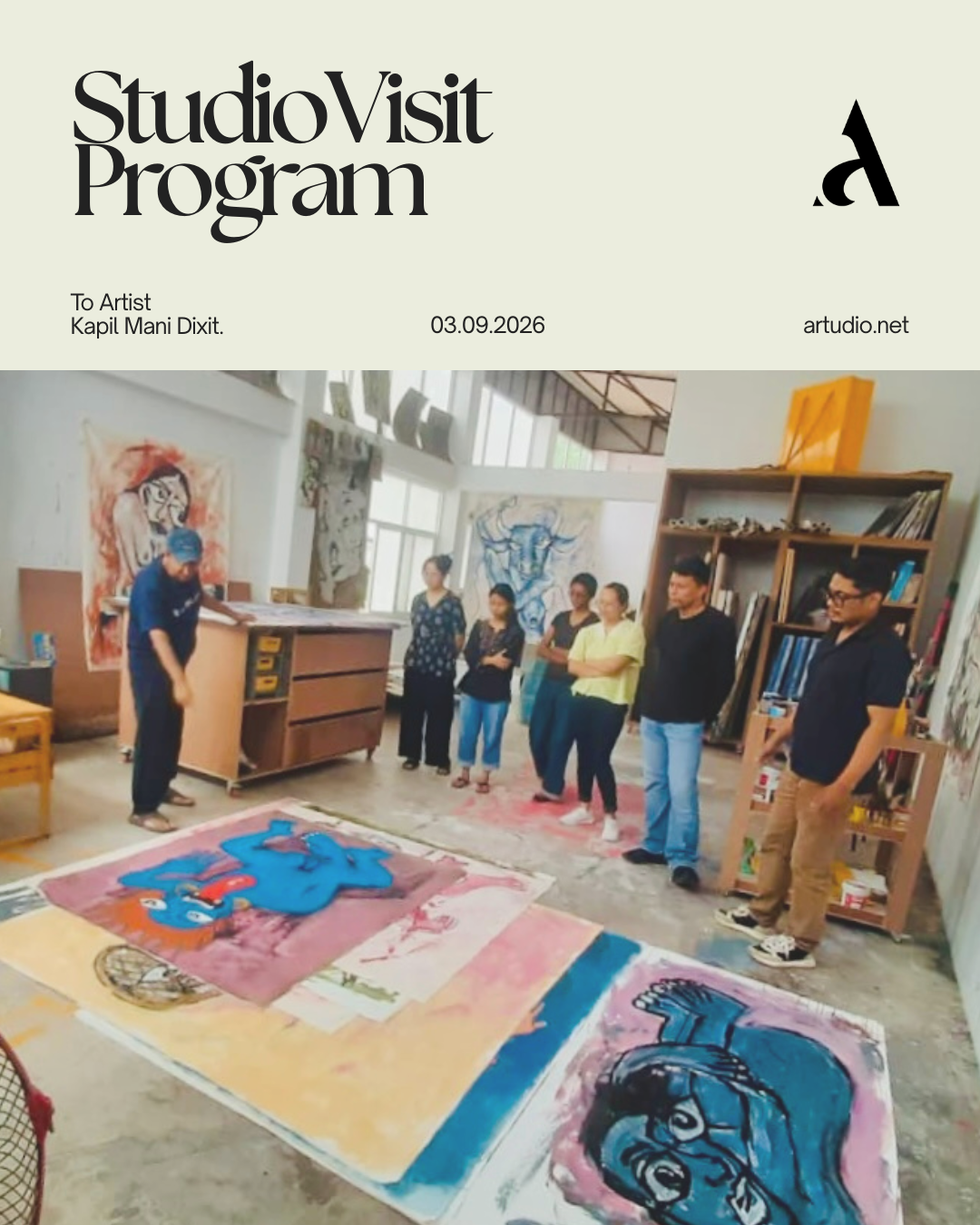
What happens when we encounter another artist’s practice—not simply by looking at their work, but by stepping into the space where it is made?
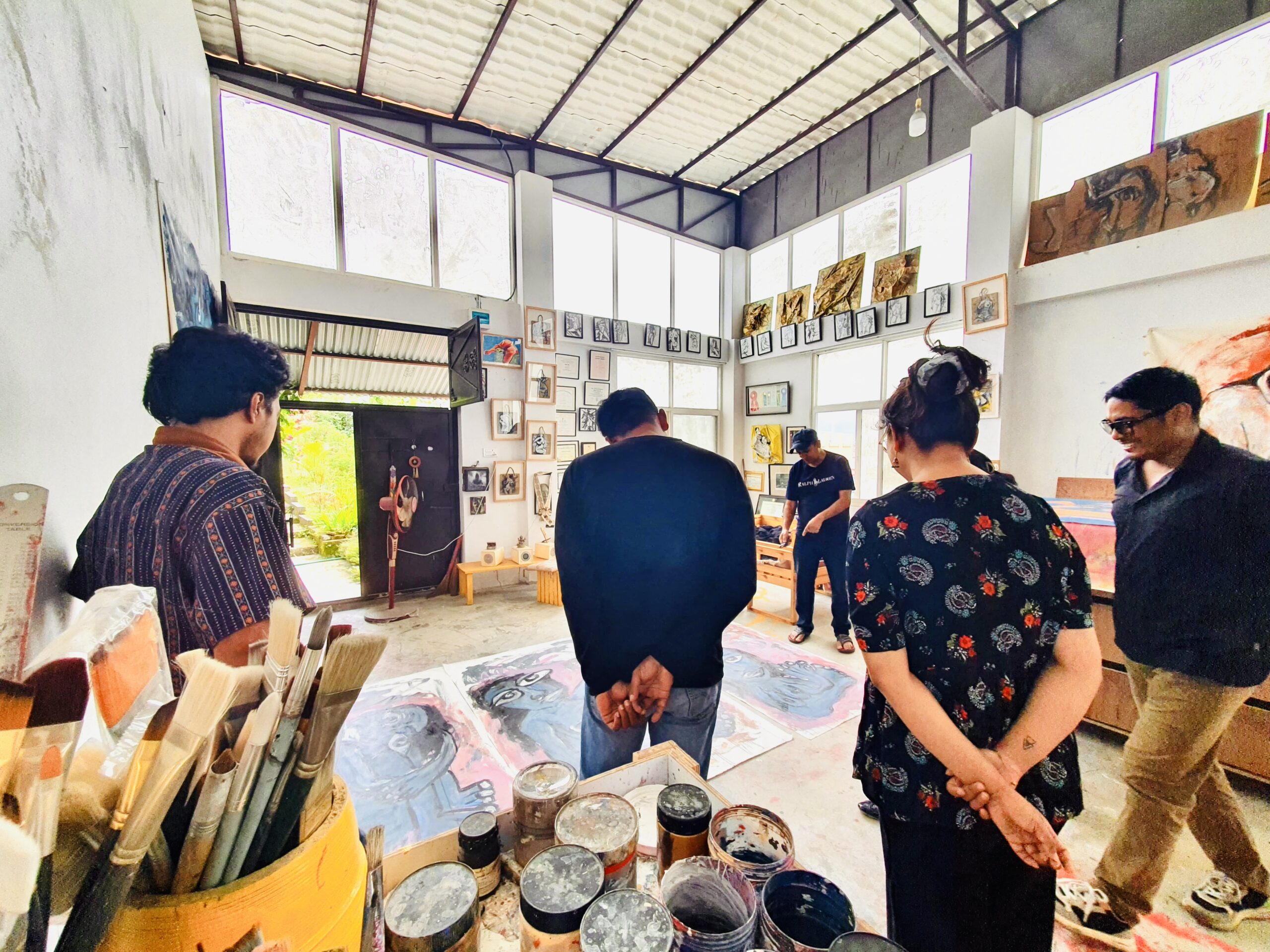
As part of Artudio’s Studio Visit Program, we recently visited artist Kapil Mani Dixit at his studio, spending time with his work, his process, and the ideas that shape his practice. The program is built around a simple idea: artists learn from artists not only through their finished works, but through encounters with their lives, spaces, processes, and ways of working.
The studio was downstairs, reached through a garden. The moment I entered through its door, something changed.
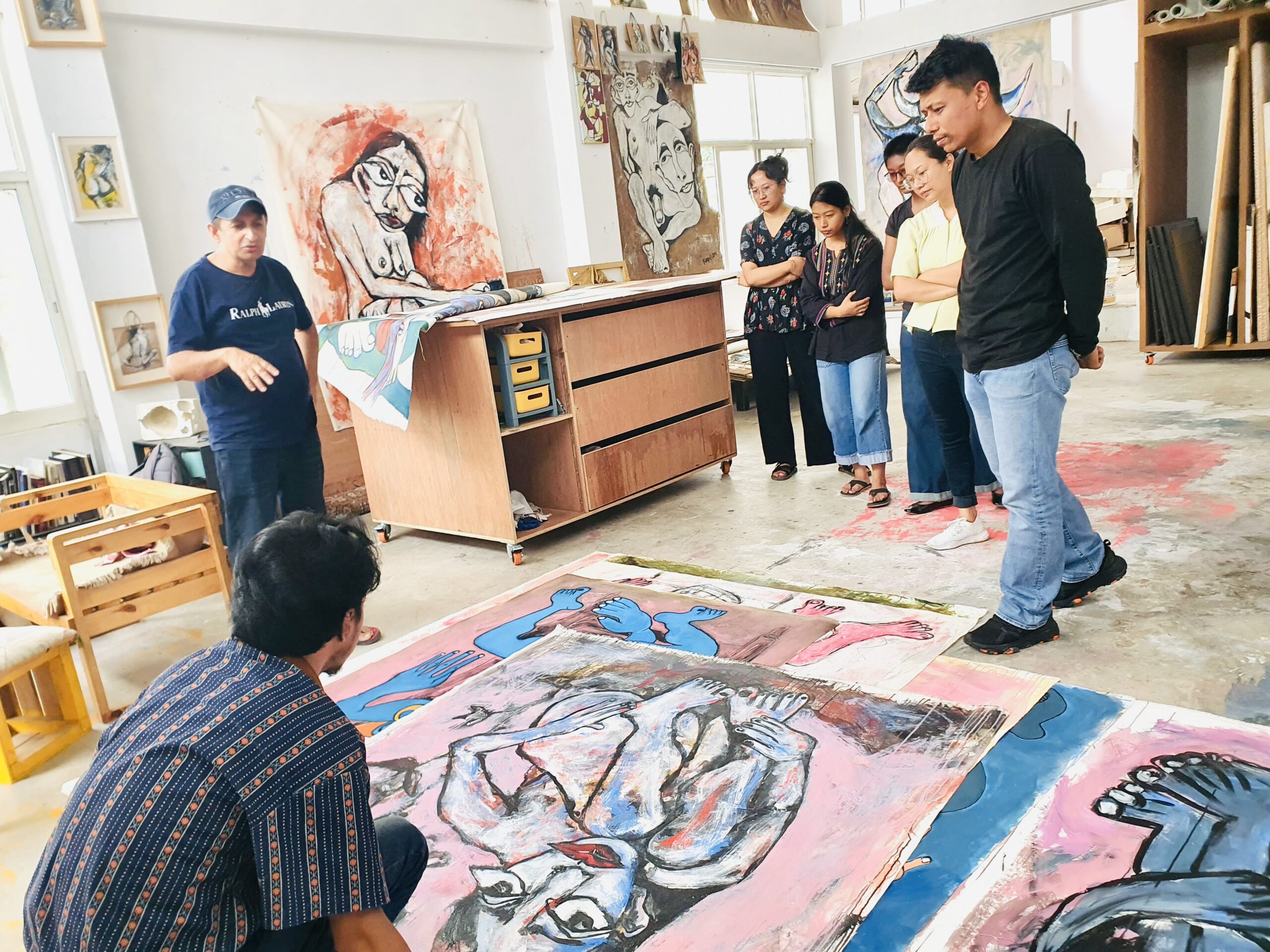
Large canvases occupied the room, leaning, hanging, waiting. Some held finished thoughts; others seemed to be in the middle of becoming something else. There was a sense that the paintings were not entirely separate from the space around them. They belonged to it, and the space seemed to belong to them.
I began to wonder if a studio can reveal an artist before the artist speaks.
Kapil Mani Dixit speaks about freedom, but what stayed with me was how little distance there seemed to be between what he believes and how he makes.
He does not always stretch his canvases.
The stretcher, for him, can become a box. A boundary arrives before the painting does. So he lets the canvas remain loose, uncontained—a surface that can move beyond the certainty of its edges.
A canvas without a frame.
The phrase stayed with me.
Perhaps because freedom in his work does not seem to mean simply breaking away. It seems to mean resisting the need to define where something should begin or end.
His paintings do not have to belong to a fixed series. A thought can enter halfway through a painting and redirect it. A bag can become a canvas. A cardboard box can become a surface for an image. A figure can change its anatomy. An organ can move. A hand can become something else.
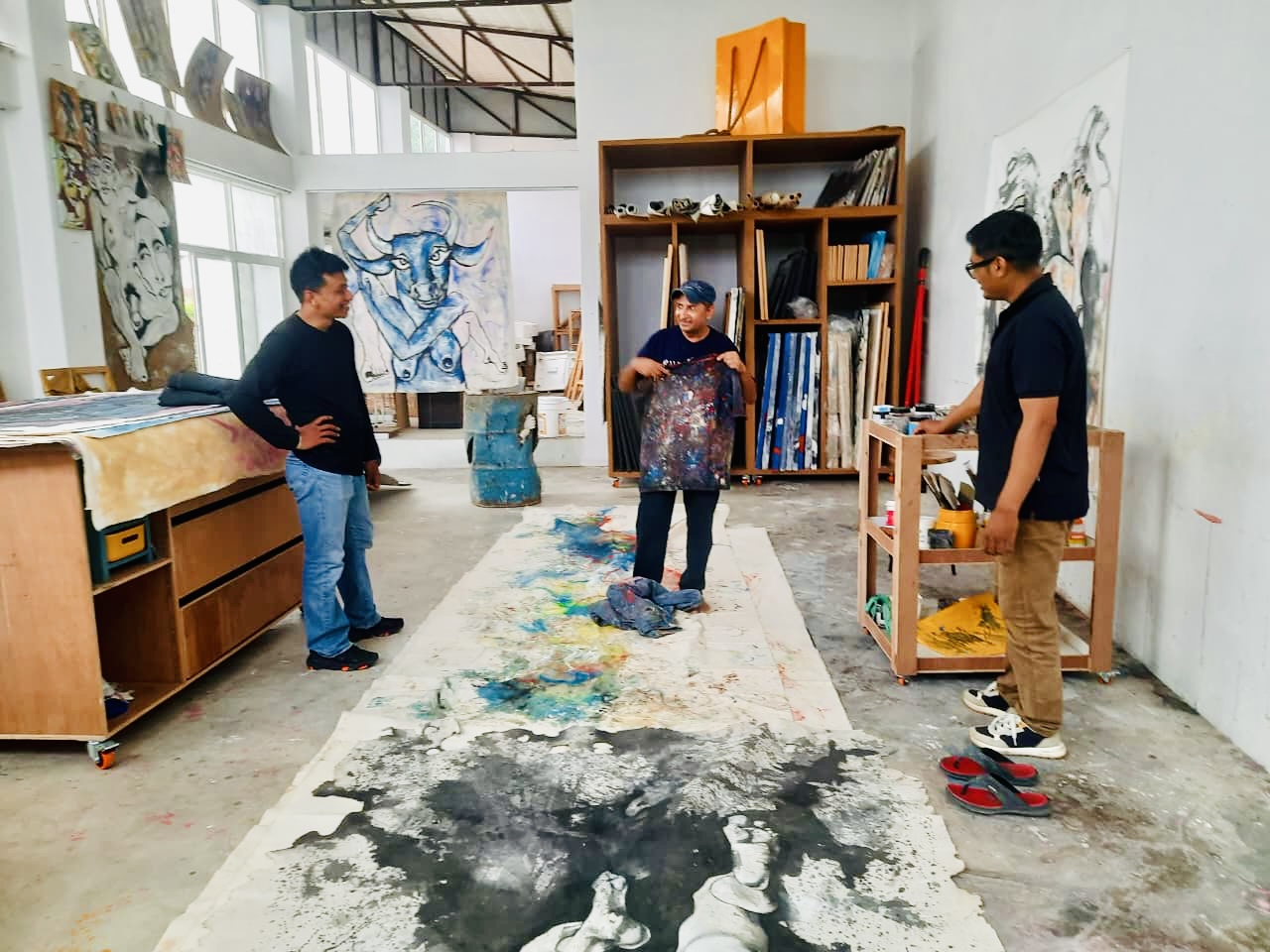
Nothing seems to require permission to become what it wants to become.
But then there is the cage.
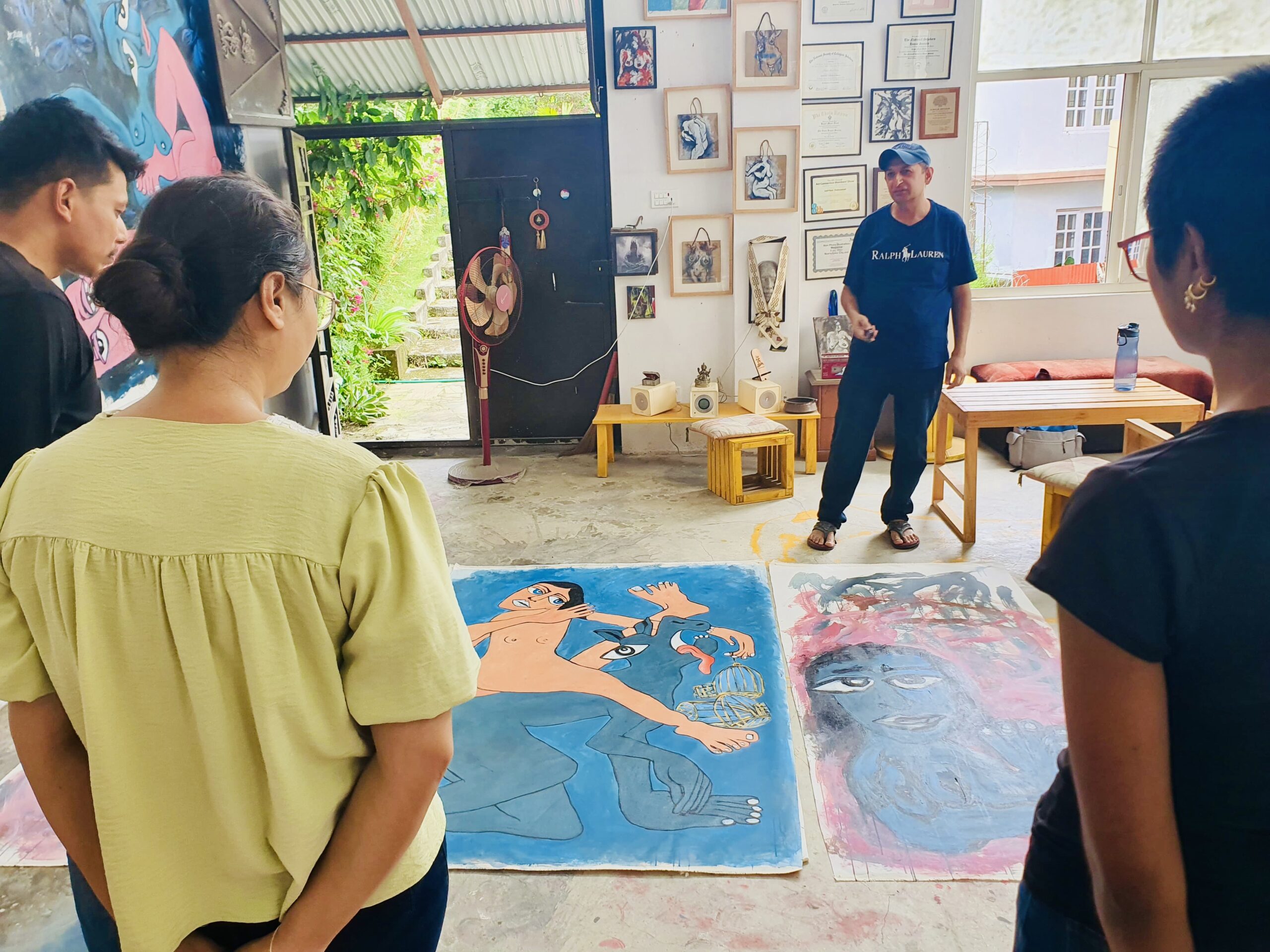
In his earlier work, the crow carried an idea of freedom. Now the image of an open cage has taken its place. At first, the open door appears to suggest escape. But an open cage can hold a more difficult question.
What if the cage is open and we still remain inside?
There are boundaries that do not need walls.
They can be inherited. Social. Gendered. Cultural. Internal.
Perhaps this is why his reflections on women and their struggles sit so naturally beside the image of the cage. The absence of bars does not necessarily mean the absence of limitation.
I kept thinking about this as he spoke about his figures.
There was another kind of cage there—the cage of the body as we know it.
During his years studying art in Texas, he carried Kathmandu’s mountains with him. Texas was flat, but the landscape in his mind was not. He tried to paint the hills he knew, but the paintings resisted him. His mentor encouraged him to let go of the mountains.
Then he entered a figure-drawing class.
And he found them again.
The mountains had moved.
They were no longer outside him, but inside the figure.
I find something beautiful in this movement: landscape becoming body, memory becoming form.
His early figures were realistic. Later, they became increasingly free from the rules of anatomy. Eyes grew large. Bodies stretched. Organs moved. Fingers appeared where fingers should not be.
The figure became another place where boundaries could be questioned.
Perhaps abstraction is not always about making something unfamiliar.
Perhaps sometimes it is about freeing something familiar from the rules we have placed around it.
His eyes seem to carry this freedom differently. They are exaggerated, almost excessive. He believes the eyes can tell an entire story on their own.
Looking at them, I began to think about seeing—not simply as looking, but as a form of attention.
To look at another person’s life closely.
To look at the restrictions they live with.
To look at a body without deciding what a body should be.
To look at a painting without asking it to become finished too quickly.
Maybe this is what I remember most from the studio: not a particular painting, but a way of looking.
The encounter made me think about the boundaries we rarely notice because we have become accustomed to them. The frame around the canvas. The rules around the body. The expectations around women. The idea that a painting should belong to a series. The assumption that a work should remain what it was when we first began making it.
What happens when we loosen these things?
A studio visit can easily become an encounter with another artist’s work. But perhaps the more interesting encounter is with another artist’s way of thinking.
Krisha Tamrakar
Director, Artudio